November 18, 2026
Fast Casual: The Moments Behind the Meal
What gets someone to choose a fast-casual restaurant? Hunger matters. Convenience matters.
Both are easy to measure and easy to compete on, which is where most of the category spends its money — speed, location, price. But none of it explains why someone drives past three options to get to a fourth.
4 minutes
So we got curious
Chemistry’s Market Research Lab surveyed 1,000 fast-casual customers using Category Entry Points, a framework that maps the moments and motivations that put a category in play. We paired it with reaction-time testing, which surfaces associations people hold but don’t think to report.
What the data showed: the most powerful dining occasions in this category aren’t meals at all. They’re moments.
Craving doesn’t check the clock.
Lunch and dinner may define when we eat. Craving can determine where we eat.
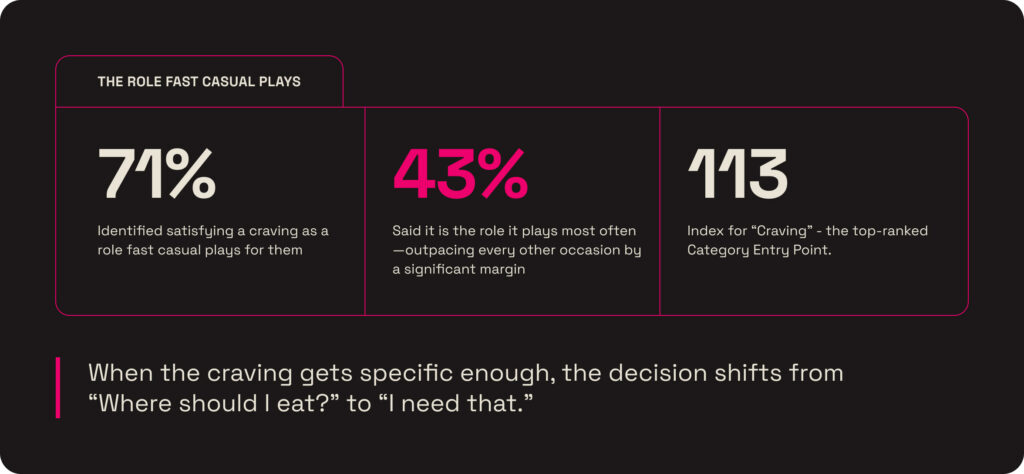
Consumers spontaneously talk about satisfying a craving as a reason to choose fast casual, and craving-related occasions emerge prominently throughout the research. 71% of respondents identified satisfying a craving as a role fast casual plays for them—and 43% said it’s the role it plays most often, outpacing every other occasion by a significant margin. In our implicit association testing, “Craving” emerged as the top-ranked Category Entry Point with an index of 113, reflecting the strongest mental link between the craving state and a specific restaurant destination.
When the craving gets specific enough, the decision shifts from “Where should I eat?” to “I need that.”
The Insight
Craving is the strongest way into this category, and it doesn’t map to a specific part of the day. Plan against the specific thing people want rather than the hour they want it.
“I earned this” is an occasion.
A long week. Payday. Finishing the errands. Getting through practice. A little win worth celebrating.
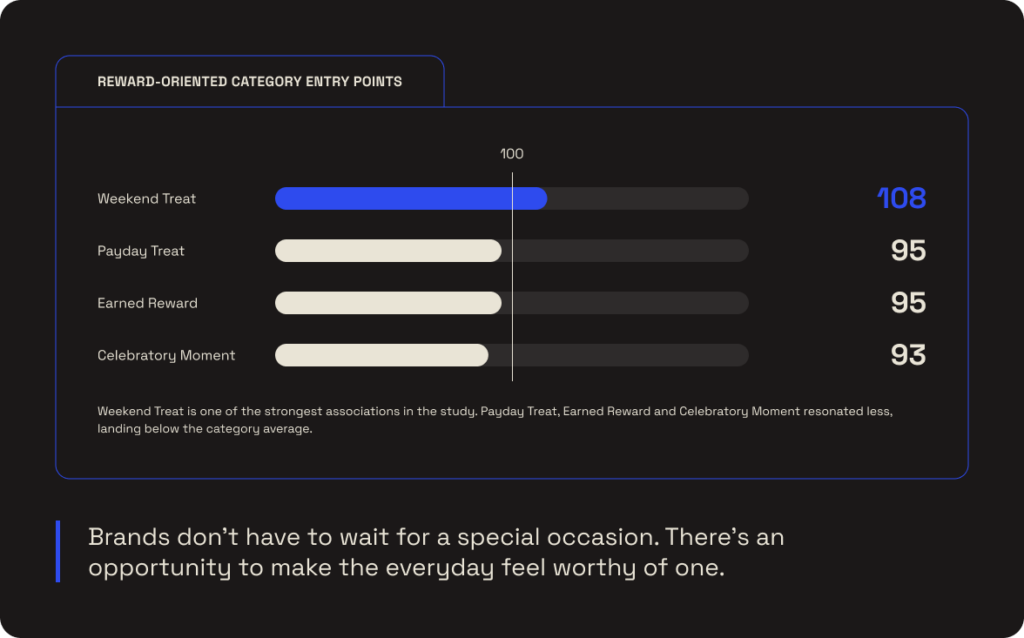
The research uncovered a constellation of reward-oriented occasions. Weekend Treat indexed at 108—one of the strongest associations—with occasions like Payday Treat (95), Earned Reward (95), and Celebratory Moment (93), resonating less.
The Insight
Brands don’t have to wait for consumers to have a special occasion. The reward frame already maps to how consumers think about fast casual. Make the ordinary weekend feel worth marking before trying to manufacture a bigger moment.
Convenience gets you into the category. Emotion can win the choice.
The functional job of fast casual is clear: 27% spontaneously mentioned being hungry/on the go, 26% saving time, and 11% not wanting to cook.
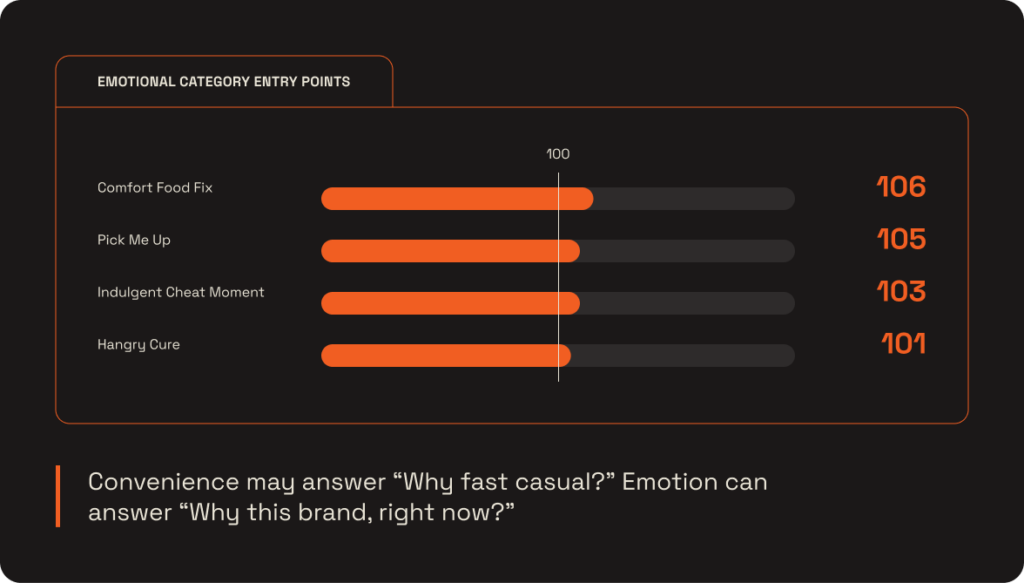
But beneath those practical needs are more emotional ones: Comfort Food Fix indexed at 106, Pick Me Up at 105, Indulgent Cheat Moment at 103, Hangry Cure at 101. These aren’t fringe occasions. They’re emotional states that are already driving real choices.
The Insight
Convenience is where the whole category competes, which is why no one wins there. The emotional states already driving choice are where a single brand can build a position competitors can’t claim.
Convenience may answer “Why fast casual?” Emotion can answer “Why this brand, right now?”
Sometimes we’re not buying food. We’re buying a feeling.
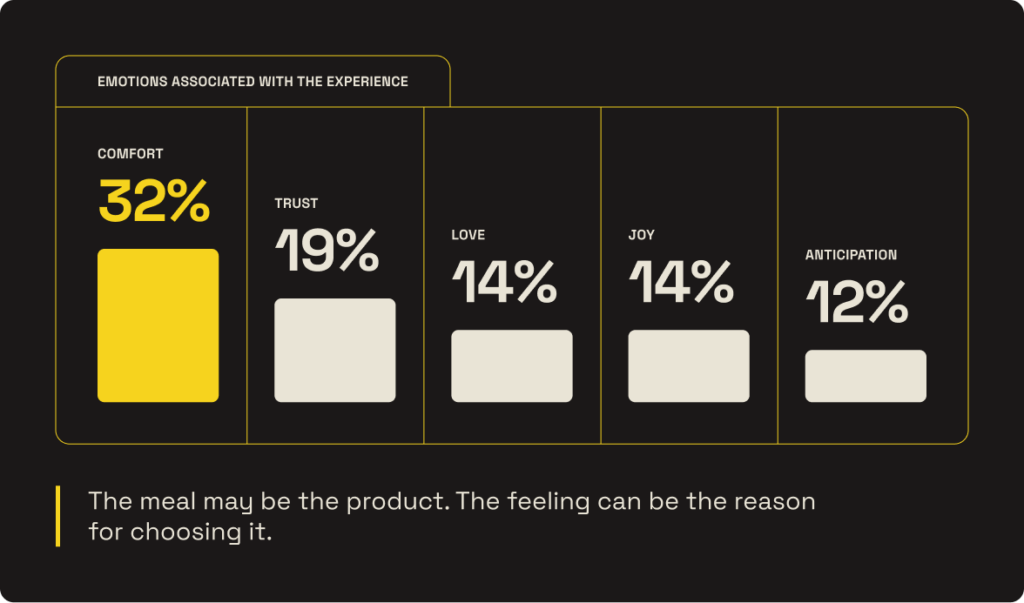
Comfort. Trust. Love. Joy. Anticipation. Those aren’t menu items—but they were among the emotions consumers associated with their restaurant experience.
Comfort led at 32%, followed by Trust at 19%, Love and Joy each at 14%, and Anticipation at 12%.
The Insight
The meal may be the product. The feeling can be the reason for choosing it. Brands that understand the emotional job they perform can build relevance around far more than breakfast, lunch and dinner.
The bottom line
Put the findings side by side and the pattern is bigger than any one of them. Craving, weekend reward, comfort, the pick-me-up—none of these are on the clock. They don’t belong to breakfast, lunch or dinner. They belong to how someone feels at a given moment.
Don’t just ask who your customer is. Understand the moments that make them hungry for you. Own the moment instead of the meal.
About the Research
Chemistry’s Market Research Lab conducted a national quantitative study among 1,000 U.S. fast-casual restaurant consumers, ages 18–64, with household incomes of $75K+ who had eaten at the study’s focal fast-casual restaurant within the past 12 months. The research used Category Entry Points (CEPs)—the needs, occasions, motivations and situations that prompt people to enter a category—along with an implicit, reaction-time-based methodology to understand which occasions consumers most strongly associate with restaurant choice. Open-ended responses and emotional associations added context around the why behind those occasions.
Related

Talley Hultgren - Chief Insights Officer
May 15, 2023
Gen Z Is Tired Of It. They’re Also Kind Of Unstoppable.
261 Gen Zers, in their own words, on what brands keep getting wrong.
Talley Hultgren - Chief Insights Officer
July 16, 2023
The Breakfast Aisle Has a Blind Spot
Only 35% of consumers eat cereal at breakfast. The rest moved on—and the marketing didn't.

Talley Hultgren - Chief Insights Officer
October 16, 2023
The New Latino Mosaic: What Brands Get Wrong About the Fastest-Growing Consumer Segment in America
What it takes to build real trust with the fastest-growing consumer segment in America.