April 8, 2026
Finding Success When the Marketing Funnel Stops Making Sense
Nonlinear behavior is forcing brands to rethink how they’re structured, measured, and aligned to meet customers where they actually are.
7 minutes

The marketing funnel isn’t broken – but it no longer works the way we’ve been using it.
For years, marketers have organized strategies around a clean, top-to-bottom funnel. Customers were expected to discover, consider, and convert in a clear sequence of events.
But digital transformation has fractured that clean path to purchase with new platforms and devices, and AI is accelerating the shift.
Today, the consumer journey is fragmented, nonlinear, and constantly shifting. Consumers aren’t moving neatly from point A to point B – they jump over, loop back, skip steps, and re-enter at will, driven by impulse, convenience, social proof, and culture.
The frameworks brands rely on to plan, measure, and organize marketing haven’t kept pace. Growth now depends on operating within a far more dynamic system of influence and demand.
The Challenge for CMOs
None of this is news to marketing teams. Most CMOs know change is required.
What’s less clear is where to start.
They’re navigating siloed teams, disconnected data, and pressure to deliver growth while budgets and resources shrink. They’re being asked to prove channel ROI, meet increasingly ambitious KPIs, and learn the new landscape as they go.
Meanwhile, the industry at large continues debating outdated binaries: brand vs. performance, short-term vs. longer-term focus, funnel vs. channel approaches. Those debates miss the point. Focusing on answering them can result in missed revenue targets and inefficient teams.
The solve isn’t choosing a side. It’s adapting to a world that no longer behaves in predictable patterns.
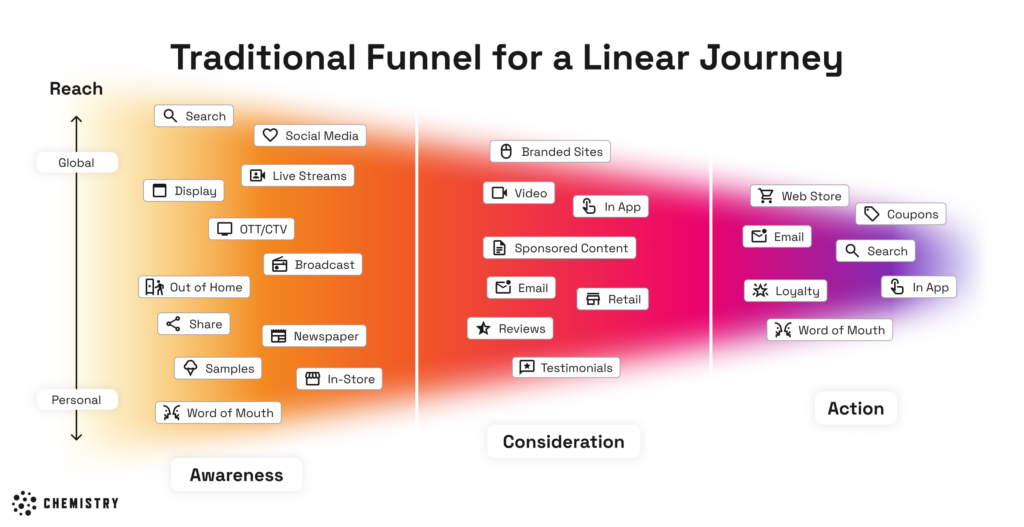
Nonlinear Doesn’t Mean No Funnel
Modern journeys may be nonlinear – but they still happen within the funnel.
Separating “upper” and “lower” strategies and tactics no longer works with how people actually make purchase decisions.
Linear funnel models fail to capture:
- Peer and creator influence
- Social virality
- Cross-device, cross-platform behavior
- The difference between impulse and repeat decisions
Discovery now happens wherever trust is already forming. Traditional ads are often no longer the first touchpoint.
Testimonials, once seen as lower-funnel assurances, now may be the first brand awareness touchpoint via a TikTok influencer recommendation. Social platforms, creator content, communities, and reviews now play an outsized role – especially for Gen Z.
A full-funnel strategy still matters, but not as a rigid sequence. Instead, it must work as a flexible system that drives awareness, consideration, and conversion simultaneously.
From Funnels to Flexibility
The new mandate is deceptively simple: meet people where they are, when they need you, with what they value.
But execution isn’t that easy.
In a dynamic demand system, the key focal point isn’t a “stage” in a funnel. It’s a decision moment: a point where a customer gains or loses confidence, revises a shortlist, or takes action. These moments are cumulative across consumer journeys. They don’t always result in a conversion, but they always influence momentum.
Search results, a creator’s recommendation, a friend’s text, a review on a marketplace, an AI summary, a store visit – each of these shapes decision moments. Some validate choice. Others eliminate options. Many factors introduce friction or provide reassurance that help determine when a customer moves forward, pauses, or disengages entirely.
Winning in this environment requires flexible, data-driven strategies designed around high-impact moments. Channels must evolve accordingly:
- Social must function as discovery and search, not just engagement
- Paid media must educate and reassure, not simply create awareness or capture demand
- Brand content, creators, PR, and community become core drivers of influence
- Third-party platforms now matter as much as owned ones
The brands that win are the ones that show up when decisions are being made – again and again – across the moments that matter most.
A More Useful Way to Think About Influence
Rather than forcing behaviors into stages, brands need to focus on core behavior states:
- Streaming: always-on content consumption
- Scrolling: passive discovery in motion
- Searching: intent-driven exploration (increasingly AI-led)
- Shopping: seamless, nonlinear transactions
As consumers ourselves, we know how these behaviors can overlap, repeat, and happen in any order. Scrolling may spark awareness, streaming builds understanding, while searching and shopping drive decisions. But influence can still occur at any moment.
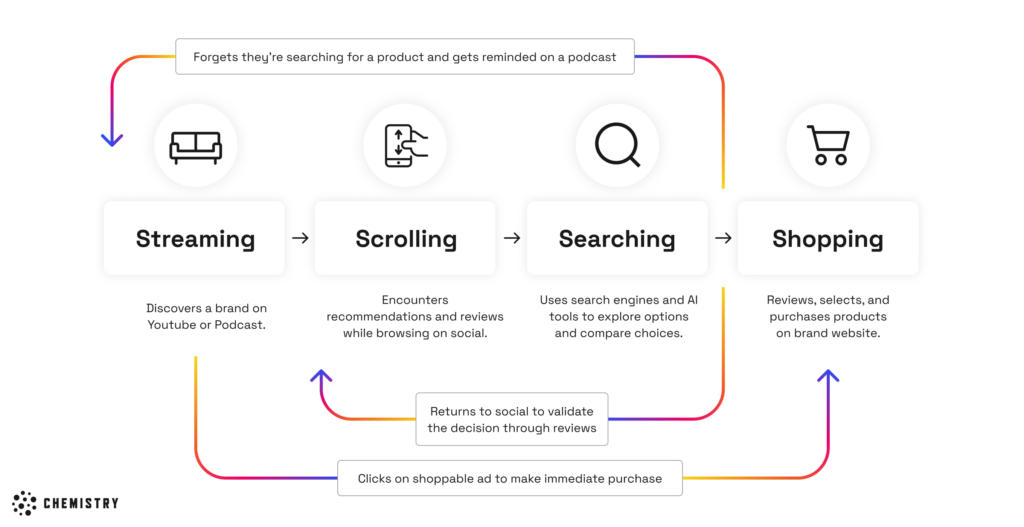
Brands must move beyond messaging to create participatory, trust-based experiences across owned and third-party channels. Meaning, relevance, and community matter as much as reach and efficiency.
The goal isn’t to push people down a path – it’s to understand how influence flows and show up accordingly.
Designing for Real Journeys
Since modern consumers don’t move down funnels but across behaviors, this requires bespoke strategies aligned to actual journey dynamics.
Journey mapping must be behavior-aware and dynamic, integrating multi-touch interactions across platforms and moments. Tailored plans align audience needs, mindsets, messaging, and channels.
Balance is key. Progressive storytelling prevents overload, builds trust, and ensures brand, education, and selling work together – rather than compete.
Rethinking Measurement for a Nonlinear Reality
In this new fragmented world, the question of ROI shifts from “Which channel drove the conversion?” to “Which combination of touchpoints moved this decision forward?”
Leading teams will begin to track beyond the last click in order to measure:
- Confidence signals: behaviors that show rising trust – saving products, subscribing, returning to key content, asking deeper questions.
- Conversion contribution: how does each touchpoint influence and reinforce action to unlock growth?
- Decision velocity: how long does it take a customer to move from the first meaningful interaction to decisive action?
Data-driven measurement requires unified data and shared definitions of success across brand, performance, and marketing channels.
What Does This Mean for Teams?
Most marketing organizations are still structured around linear models – separating brand, performance, social, and analytics.
Those teams often operate with:
- Brand focused on reach and storytelling with limited visibility to downstream impact.
- Content prioritizing resources for discoverability over decision-making.
- Performance and e-commerce chasing short-term efficiencies, even when it undermines long-term loyalty.
- Social and creator teams measured on engagement, separated from revenue and retention outcomes.
On paper, each function appears successful under the old ways of thinking. In practice, customers are experiencing a patchwork of messages that don’t add up to a seamless brand experience.
Success now requires:
- Shared goals and unified measurement: establishing a single set of growth outcomes that every team contributes to
- Cross-functional alignment: breaking down silos to build coordinated teams centered around key goals, working in lockstep
- Flexible, journey-led planning: shifting from static channel plans to dynamic, moment-based strategies that prioritize where confidence is built or lost
Complex journeys demand integrated thinking – strategy alongside creative, media alongside data, brand alongside performance.
“In our work, we’ve seen growth accelerate when brands stop designing for a single journey and start connecting the moments that actually shape decisions. The strategies that are integrated, behavior-led, and built around how people really navigate choice are the ones that win.”
– Javier Santana, Chief Experience Officer
The Bottom Line
Brands that win will embrace flexibility, rethink influence, and organize around real customer behavior – not outdated models.
As much as everything has changed, one thing hasn’t: success still comes from understanding your customers and meeting them where they actually are.
Related

Kam McCullough - EVP of Experiential & Influencer
September 16, 2026
Please Stop Influencing the Experience
The answer isn’t fewer creators. It’s a better strategic approach with a focus on intention and curation.

Clint Godlesky - Director, Technology & Innovation
August 26, 2026
Brand, Law, and Reality: The State of Web Accessibility
One in four American adults has a disability. 95.9% of major websites fail to serve them. We’re breaking down why.

Dafne Rodriguez - Lead Digital Strategist
July 29, 2026
Beyond the Inbox: The New Role of CRM
Most companies are sitting on a CRM that can do ten times more than they're asking of it.