September 16, 2026
Please Stop Influencing the Experience
Influencer marketing was built for the internet. The next challenge is figuring out how to behave when the internet isn’t the only audience in the room.
9 minutes

It’s time to just say what everyone in the industry is thinking but is probably too polite to say:
Influencer marketing is getting a little insufferable.
And before the creator economy gets defensive, this isn’t an indictment of creators. It’s an indictment of the system we’ve built around them.
We’ve all seen the backlash. The US Open. New York Fashion Week. Concerts. Sporting events. Brand activations. More and more, the public reaction is less “Wow, what a cool creator experience,” and more “Can you please get out of the way?”
From creators retaking their 9th photo of a Honey Deuce between Coco Gauff sets to soliciting Mayor Mamdani on Threads for free housing during NYFW, we’ve lost the plot.
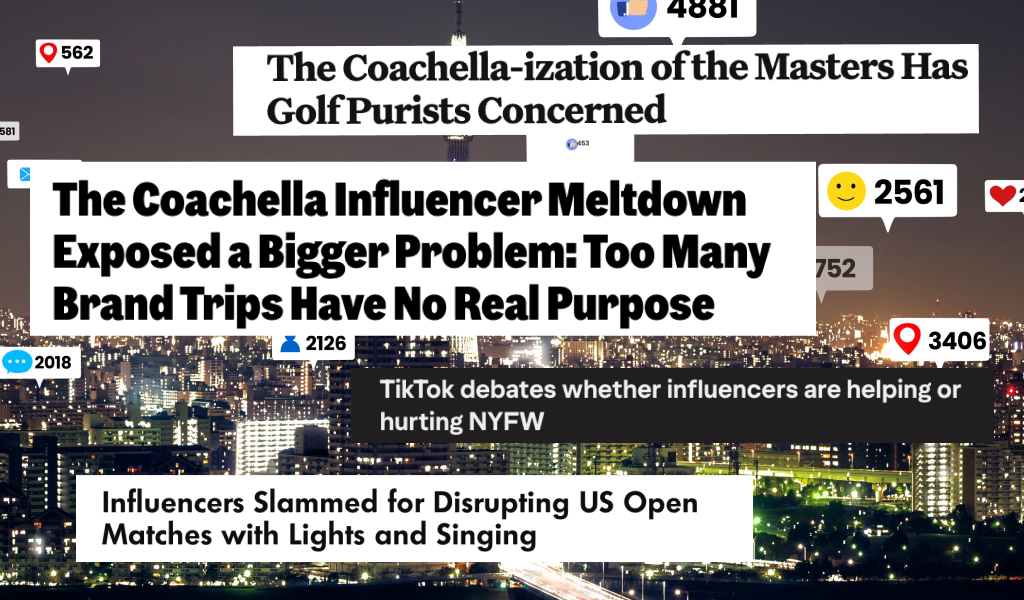
At some point, we have to acknowledge that the audience is beginning to resent the marketing, and that defeats the purpose.
People don’t hate influencers. I think people hate when the influencer becomes more important than the experience.
When something they paid their hard-earned money to experience becomes a content studio.
When something that is meant to be appreciated is constantly interrupted.
When they can’t see their favorite artist’s intimate Blue Note performance because they’re blinded by a ring light inside of a ring light.
The industry has spent years telling brands that creators are the most authentic way to connect with audiences. But if we’re not careful, we’re going to dilute that authenticity because we have started optimizing for content at the expense of culture.
The Internet Has Different Rules
The internet rewards interruption, IRL not so much. The loudest person online often wins. In a stadium, theater or fashion show, the loudest person might just be the person everyone wishes wasn’t there.
Online, you’re the main character. IRL, you’re sharing the room with hundreds or thousands of other people who also paid to be there. That’s the rub we’re experiencing right now.
Influencer marketing was built for the internet. But increasingly, we’re asking it to operate in physical spaces without adapting the rules. The creator economy has taught us how to capture attention, and now we need to learn how to share it.
We Have an Industry-Wide Problem
There is an unspoken truth in influencer marketing right now:
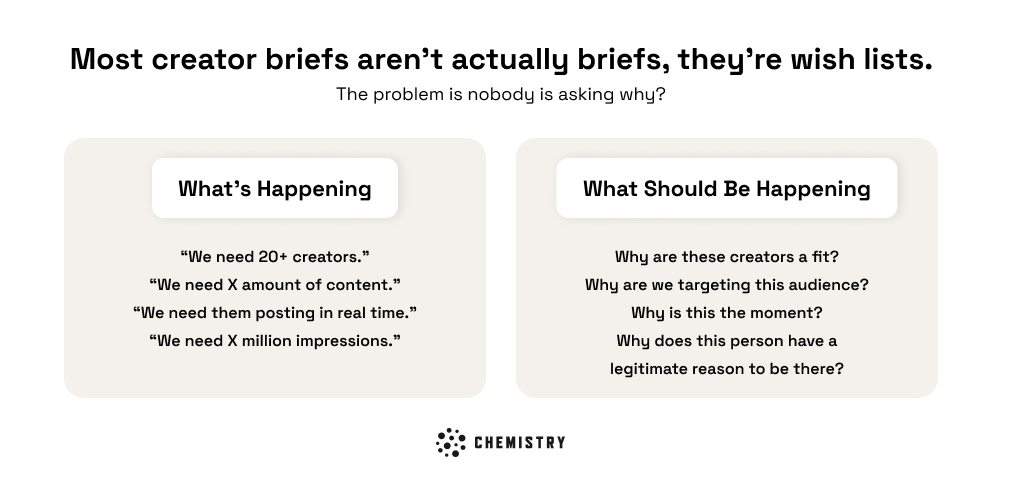
Asking why actually gets us to even more important questions like…
What are they adding to the experience?
What does their audience stand to gain from this?
What happens to the people who aren’t part of the campaign?
These types of questions shape a more comprehensive and impactful brief. Those aren’t anti-influencer questions, they’re the base level for our thinking. As creator budgets have exploded, the rigor around the strategy hasn’t always kept pace. A channel that was once an experimental tactic has become a primary way brands build awareness, shape perception and enter culture. We are putting creators at the top of the funnel and still briefing them like they’re an afterthought.
We Confused Access With Value
Somewhere along the way, we started confusing access with value.
Give a creator a courtside seat and assume the content will be valuable.
Put them backstage and assume the audience will care.
Give them a front-row seat at Fashion Week and assume their presence automatically makes the brand culturally relevant.
It doesn’t.
Access is not a strategy.
Being in the room doesn’t make someone culturally relevant, and being a creator doesn’t mean every room you’re in needs to become a content hub.
Sometimes the creator should be the story.
Sometimes they should document the story.
Sometimes they should participate in the story.
And sometimes they should simply experience the story.
The brief should tell us which one.
We Have Turned People Into Media Placements
This is probably the biggest mistake we’re making. We talk about creators in the same language we talk about media inventory.
Reach.
Impressions.
CPM.
Frequency.
Deliverables.
Optimization.
But creators aren’t billboards, they’re humans with an ability to connect deeply. Their value isn’t simply that they have an audience. It’s that they’ve built a relationship with that audience. That relationship is a part of the product as well their taste, POV and trust that they’ve built. And the minute we treat that relationship like inventory, we start destroying the very thing we’re trying to tap into.
We’ve become incredibly sophisticated at measuring the output of influence while becoming increasingly careless about what creates influence in the first place. That has been and will always be trust, and trust isn’t scalable just because the creator’s follower count is.
Let’s Be Fair: The Creator Isn’t Always the Problem
We need to be honest about who created the conditions for this behavior.
Someone invited them.
Someone wrote the brief.
Someone approved the deliverables.
Someone decided that a tennis match needed a content capture strategy.
Someone decided that a cultural moment needed to produce a certain number of assets.
We can’t outsource strategic judgment to the creator and then blame them when the strategy doesn’t land. Creators are doing what the industry has incentivized them to do: capture attention, create content and maximize the value of the access we’ve given them. If we want different behavior, we need to brief for it.
The Audience Is Part of the Brief
There’s another stakeholder we’ve conveniently left out of a lot of creator briefs:
Everyone else.
The fan who spent $500 to watch a tennis match doesn’t care about your content deliverables.
The person who waited six hours to get into a concert doesn’t care that a creator needs another take.
The designer who spent six months building a collection doesn’t want the runway overshadowed by someone filming themselves walking into the venue.
And the person who actually lives in the neighborhood you’re activating in probably doesn’t care about your engagement rate.
They’re the people and communities experiencing culture in real time, and we’ve failed when our marketing starts degrading that experience. The audience should feel less like an obstacle to the campaign, and more like a consideration of it.
Not Everything Needs to Be Content
We’ve reached a strange point in marketing where if something isn’t captured, posted, measured and turned into a case study, we act like it didn’t happen. That’s not how culture moves or works. Some of the most powerful experiences happen before anyone pulls out a phone. It could be a surprise they weren’t expecting or a connection that they organically made. Those moments don’t always need to become content. Sometimes the content should be the byproduct of the experience, not the experience itself. Culture doesn’t exist to serve our content, content lives inside culture.
That’s the distinction we’re losing.
“What If We Don’t Post?”
Maybe the easiest way to fix all of this is to ask a question that might make decision makers a little uncomfortable:
What happens if we don’t post?
Before we approve an influencer activation, we should be able to answer that question. If the answer is, “The experience is still incredibly valuable,” that’s a good sign. If the answer is, “Then what’s the point?” We may have built a commercial shoot disguised as a cultural experience.
Not every moment needs to be documented.
Not every creator needs to post.
Not every brand experience needs to become a case study.
Sometimes everyone can simply experience the thing, and the brand can be part of something without trying to own every second of it. This is what is looks like to be a participant in culture and not just a purveyor. The former procures better sentiment over time.
The New Influencer Brief
The answer isn’t fewer creators. It’s a better strategic approach with a focus on intention and curation. Before we put a creator into a cultural moment, we should be able to answer five questions:
Why them?
Why here?
Why now?
What do they add?
And what does everyone else get out of it?
If we can’t answer those questions, we don’t have an influencer strategy. We have a guest list with a budget. The next era of influencer marketing won’t be won by whoever can generate the most content. It will be won by those who understand when and how to participate. Because influence has never been about visibility, it’s about knowing why you’re in the room in the first place.
People don’t hate influencers. They hate when the marketing tries to becomes more of the moment than the actual moment.
So it’s on us to stop asking how we can get more creators into the room and drive ROI, and start asking why they should be there in the first place. That flip will actually produce the ROI we’re looking for. We should be trying to create the most meaning, not the most content.
The brief is the quality control.
Related

Dafne Rodriguez - Lead Digital Strategist
July 29, 2026
Beyond the Inbox: The New Role of CRM
Most companies are sitting on a CRM that can do ten times more than they're asking of it.

Chuck Cramer - Director, SEO
July 1, 2026
Budget Shifts That Paid Off: How Cutting Ads Unlocked Free Traffic & Conversions
Ranking #1 organically while bidding on the same keyword? You might just be paying for a click you already owned.
Kam McCullough - EVP, Experiential & Influencer
April 20, 2026
The Festival Was Never the Problem. The Brief Was.
From Coachella chaos to Gen Z's co-creation expectations, this piece lays out why the brand-as-director model is broken and what a creator-first approach actually looks like.