November 4, 2026
Identity Meets Experience: Your Brand Guide’s Digital Upgrade
Brand consistency used to be simpler. If you had the right logo, colors, and fonts applied consistently across your print ad, storefront, and TV spot, you were in pretty good shape.
Now your brand has to hold together across a website, an app, a portal, and a handful of other digital touchpoints that customers move between without thinking twice, often in the same five minutes. Reaching and converting these customers requires cultivating strong brand recognition and reinforcement across all of that, plus connecting seamlessly to your physical-world presence. No problem, right?
Brand consistency is no longer just making sure the specs are correct. It’s about creating a unified experience everywhere your brand appears. This is where a digital design system becomes the natural extension of a traditional brand guide.
9 minutes

Unlike a brand guide, which focuses on the foundation of your organizational identity, a design system is the foundation for your digital ecosystem. It defines the components, styles, and standards that keep the look and feel of your digital products and experiences consistent.
Both tools establish the rules that ensure a company looks and sounds the same, regardless of who creates the marketing materials or where the brand appears. When combined, they significantly increase the reach of these efforts.
Design system 101
Imagine your brand as a LEGO set. Similar to LEGO bricks, the components in a design system act as a base set of building blocks for bringing your ideas to life. Rather than leaving key decisions to individual marketers, designers, or developers, the design system gives them a toolkit of reusable components and documented patterns to choose from. It makes spinning up new digital initiatives significantly easier, and when the easy work is already done for you, the main focus can shift to the special details that add real value.
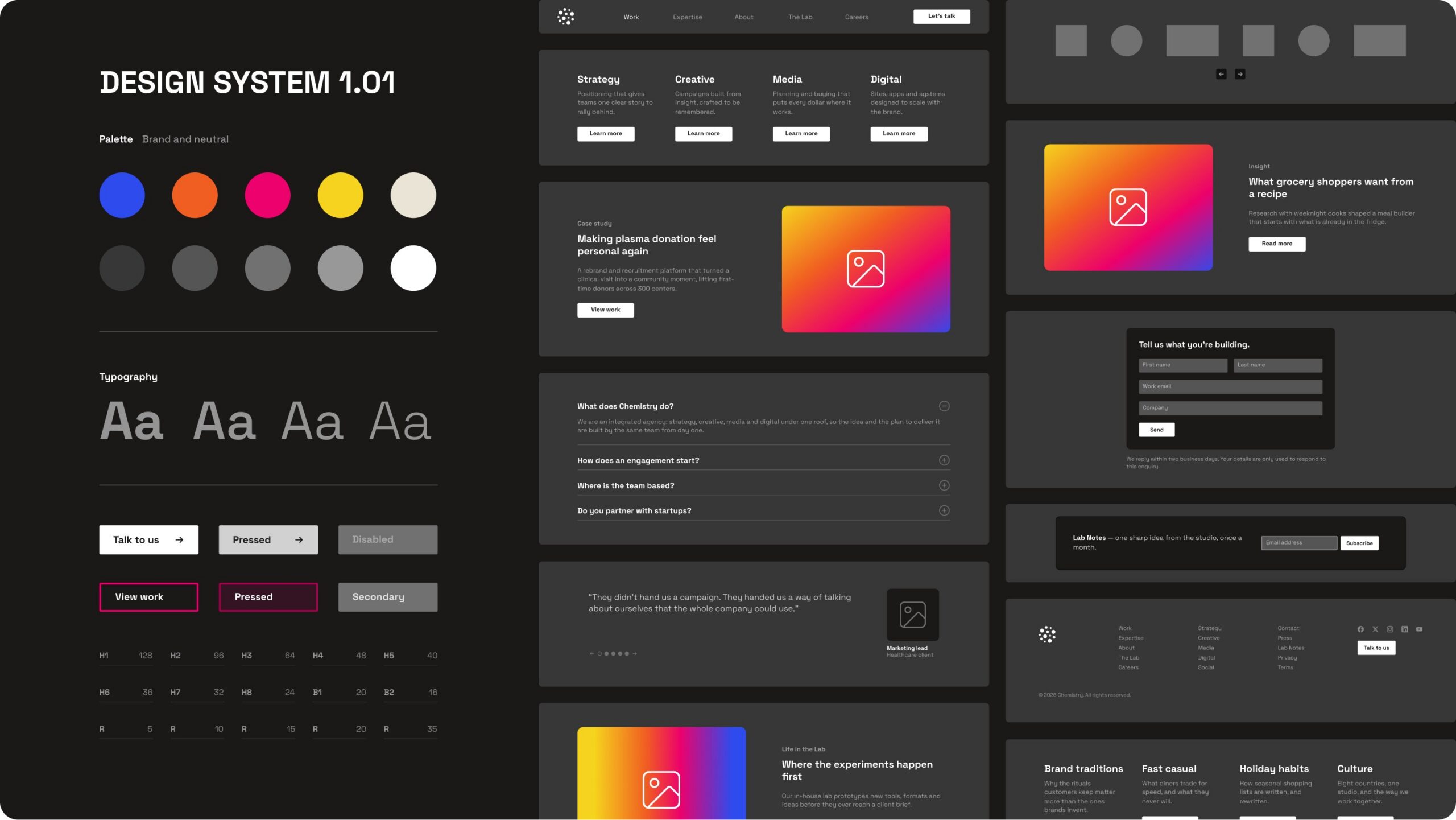

The tool of the trade: Here at Chemistry, we use a cloud-based program called Figma, the industry standard for building design systems. It allows teams to build and grow reusable, scalable UI components and collaborate with peers and clients in real time.
Finding inspiration in chemistry
A well-known methodology that many designers follow when building design systems is called atomic design. It simplifies digital design principles and hierarchy in terms of basic scientific structure. Atoms combine to form molecules. Molecules combine to form more complex organisms. And so on. These scientific terms can be applied to many of the elements that make up digital designs:
- Atoms: Foundational elements – buttons, inputs, icons, images, etc.
- Molecules: Simple combinations of atoms – header/footer, search bars, forms, cards, etc.
- Organisms: Complex combinations of atoms and molecules – these are what we typically define as the “content blocks” that make up a page design.

Regardless of whether you use this nomenclature in your own design system, it’s still good hierarchical inspiration to keep in mind.
Where brands get it wrong
Over the years, we’ve seen this same scenario play out again and again.
Regional or departmental teams build landing pages independently, each with their own idea of what “on-brand” means. One team’s button doesn’t match another’s. “Primary blue” gets defined three different ways. Without a shared system, every team builds its own version of the brand.
Once we bring a shared design system into the mix, that pattern breaks. New pages get built faster, brand-consistency issues stop showing up in QA, and teams stop reinventing the same components every time they start something new.
The cost of building the right system at the wrong time
One of the biggest mistakes we see is treating the design system as an afterthought on a website redesign project. It should really be part of the conversation from day one. In fact, when a redesign is done well, the design system doesn’t need to be a separate initiative at all. It comes together naturally as a byproduct of the work itself. By the time the redesign launches, you don’t just have a new website; you have a future-ready system that captures everything you learned along the way.
When the design system is an afterthought, the cost shows up everywhere. Designers rebuild the same components over and over, developers interpret ambiguous specs differently, and customers experience a brand that feels different depending on which door they walked through. By the time leadership notices, the fix costs a lot more than it would have to just build it right the first time.
Proof it works at scale
You don’t have to take our word for it. Big brands have made design systems a real competitive advantage. Atlassian’s design system grew alongside Jira, Confluence, Trello and Bitbucket—four products with four very different histories. Now, it makes them feel like a family instead of four unrelated tools wearing the same logo.
Salesforce does something similar with its Lightning Design System, built to bring order to the dense, data-heavy screens (forms, tables, record pages) that enterprise software runs on.
Different brands, same lesson: a design system is what keeps a sprawling digital footprint feeling like one brand instead of a patchwork of products.
What makes a digital design system a game-changer for your brand?
Building a design system can sound like a huge undertaking, whether you’re doing it internally or with an agency partner, but in practice, it’s really the opposite. Once it’s built, a design system is what makes everything that comes after it easier: fewer one-off decisions to make, fewer inconsistencies to track down and fix, and a faster path from idea to launch.
Reinforcing trust with every interaction
Organizations increasingly compete on customer experience, and seamless, familiar experiences build trust with customers faster than a more disconnected approach. Customers may not consciously notice whether every button follows the same design specification, but they immediately recognize when experiences feel intuitive, reliable, and connected. That perception is exactly what turns into conversions, retention, and referrals.
Improving efficiency while empowering creativity
Some organizations, and even designers, worry that a design system will limit creativity. It’s a valid concern, but in practice, the opposite is true. With the basic framework locked down, designers and developers spend less time recreating standard elements and more time injecting creativity into content graphics and innovating new features, all while moving more efficiently than they would with a less systemized approach.
A common language for design and development
A traditional brand guide primarily speaks to designers and marketers, with few, if any, nods to developers. A digital design system bridges that gap by defining and documenting design specifications in terms and criteria that developers can work with. This reduces ambiguity and friction, speeds up build time, and improves the overall quality of each launch.
CMS-friendly design, from the ground up
Whether it’s a traditional CMS like WordPress, a headless CMS like Contentful, or something custom-made, today’s organizations often opt for the flexibility and sustainability of a CMS-based website. Much like a CMS, a design system assembles experiences from predefined building blocks. With so many structural similarities, it becomes easier to define exactly what each component needs, leading to cleaner, more focused content blocks.
Baked-in accessibility success
Digital accessibility is no longer just a best practice. In the United States and much of Europe, it is an enforceable civil rights law. Meeting compliance can be a hurdle for many brands, but there are smart ways to ease the burden of adhering to these rules.
Accessibility is easiest to maintain when it starts at the brand guide level. Color palettes that are built from the ground up to include compliant contrast rules are the easiest to maintain cohesion across all platforms. This alleviates the need to create “digital-only” colors in your brand palette. And it shifts accessibility from being a compliance exercise to becoming a core part of the brand experience.
In addition to color contrast, digital design systems can take that one step further by considering accessible motion, functional controls, responsive layouts, and user-friendly navigation patterns.
Consistency that scales as you do
As your organization grows, your internal team grows. The number of digital platforms and tools you use is also likely to grow. If a new marketer is designing and publishing a landing page, they should have everything they need to make it look and function the way it’s supposed to. Without a shared design system, each individual may interpret brand nuances differently, and when small inconsistencies start to add up, you’re left with a fragmented customer experience.
Keeping pace with AI tools
Personalization and AI-generated content are making digital experiences more and more dynamic, which means consistency matters now more than ever. When content and layouts are being assembled on the fly, a design system is what keeps every version of that experience recognizably yours, and gives your AI tools a clear, on-brand foundation to build from instead of a blank page to guess at. As experiences get more automated, that foundation becomes even more important.
That’s a long list of reasons, and it keeps growing as digital experiences get more complex.
Built for the future
Much like a brand guide, a design system is a living asset. New components are built to serve new needs, and existing components are upgraded to work harder. Digital design systems evolve faster to keep up with new tools and emerging innovation, and as customer expectations and challenges change, the design system grows alongside them.
A digital design system is a smart extension of your long-standing, traditional brand guide. It takes a practice that has worked for brands for decades and future-proofs it for the decades to come. Whether it’s something you endeavor to build internally or you partner with an agency, a digital design system is one of the most valuable tools you can add to your brand toolkit in 2026 and beyond.
Related

Kam McCullough - EVP of Experiential & Influencer
September 16, 2026
Please Stop Influencing the Experience
The answer isn’t fewer creators. It’s a better strategic approach with a focus on intention and curation.

Kelly Brown - Lead Content Strategist
September 23, 2026
Keeping Content Human in the Age of AI
The smartest way to get a brand surfaced by AI is also the oldest: write something a human actually wants to read.

Clint Godlesky - Director, Technology & Innovation
August 26, 2026
Brand, Law, and Reality: The State of Web Accessibility
One in four American adults has a disability. 95.9% of major websites fail to serve them. We’re breaking down why.